Start with what you want to know at the helm
Pontoon boats are usually run by someone watching depth more than they watch fish. Shallow bars, sandbars and stump flats are the real worry, and the question at the helm is simple: how much water is under me, and what is the temperature. That is a depth sounder job.
If you also want to locate fish, see weed edges on a screen, save a waypoint on a hump so you can come back to it, you are asking for a fish finder instead. Both fit a pontoon. They are not the same purchase.
In-dash depth sounders: the simple answer
Three HawkEye in-dash units in the shop cover the depth-and-temperature job. They mount into the console panel and read out on a small display, so nothing hangs off the boat and there is no bracket to route cable around.
- HawkEye D10DX in-dash depth finder — the one to look at first if you want temperature. It reads depth plus air and water temperature, runs 2D sonar, and carries an IPX5 water-resistance rating. No GPS, no chart, no fish arching on a screen.
- HawkEye DepthTrax Edge in-dash depth finder — the same in-dash idea without the air and water temperature readout. IPX5 rated, no GPS.
- HawkEye in-dash digital depth sounder — the most compact of the three: a 2 inch diameter unit, 1.75 inches deep behind the panel, with a polarized LCD reading about 0.87 by 1.65 inches. The listing specifies 11–14V DC at 200mA max, a 14 degree beam angle, and a combination transom or glue-in in-hull transducer.
On a pontoon the panel depth matters. That 1.75 inch body has to clear the back of the console, the wiring and any gauge cluster already there. Measure before you cut, and check how the unit is fastened into the panel.
When a fish finder earns its spot
Plenty of pontoon owners fish seriously — crappie on brush piles, bass along a weed line, walleye over a break. For that you want a screen, not a number. The listings that suit a pontoon console are the compact ones, because a pontoon dash has less real estate than a bass boat.
- Garmin STRIKER Vivid 4cv — 4 inch screen, 2D and down scanning sonar, GT20 transducer, high-sensitivity GPS for marking waypoints and reading speed. IPX7.
- Garmin STRIKER Vivid 5cv with GT20-TM transducer — the same sonar package on a 5 inch screen, useful when you sit further from the unit than a bass boat's cockpit does.
- Humminbird HELIX 5 CHIRP GPS G3 — 5 inch CHIRP sonar and chartplotter with US freshwater and saltwater maps built in, IPX7, listed at 0.615 amp draw, which suits a pontoon's house battery and a long day on the water.
None of these is waterproof-and-forget. An open pontoon console takes spray and rain, so keep the unit where water runs off, not where it pools.
Mounting the transducer on a pontoon
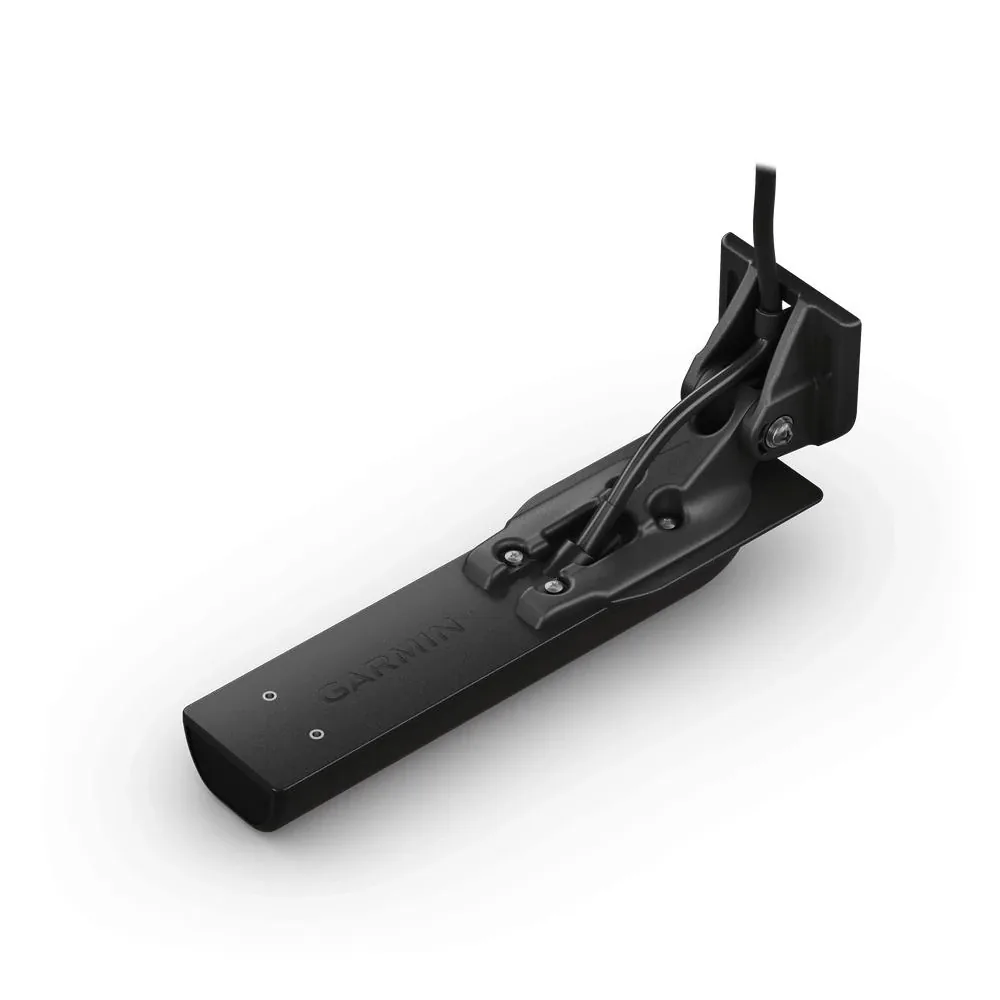
A pontoon hull is not a fiberglass V. There is no flat transom face to screw a bracket to, and the tubes are aluminum. In practice the transducer ends up on a bracket off the motor pod or the aft log, or on the trolling motor if you have one. Get the mount wrong and you get a depth reading that blanks out at speed or reads the prop wash instead of the bottom.
That is the part worth doing before you pay. Send Deepline the boat and the unit you are looking at, and we check the mounting and the connector against your boat before the invoice goes out. The transducer guide covers mount types, frequencies and connectors in more detail.
A quick way to choose
- Depth and water temperature only, clean dash, no extra screen: HawkEye D10DX.
- Depth only, smallest possible footprint: HawkEye in-dash digital depth sounder.
- Depth now, fish and waypoints later: spend the money once on a fish finder with GPS rather than buying both.
If you are not sure which way your boat leans, ask before you buy — that conversation is free and it is the cheapest mistake to avoid.