The problem it solves
Most hulls are not flat where a thru-hull transducer goes. A deep-V has deadrise: the bottom rises away from the keel at an angle, often 12° to 20°. Bolt a standard flat-faced housing into that surface and the whole transducer leans with the hull. The beam leaves at the same angle, so you are sounding a slant instead of a plumb line.
That shows up in three ways. The bottom reads deeper than it is because the pulse travels the hypotenuse, not the vertical. Fish marks sit off to one side of where the fish actually are. And at planing speed the beam skips off the surface sooner, so you lose bottom in exactly the water where you wanted it.
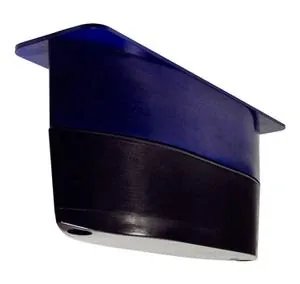
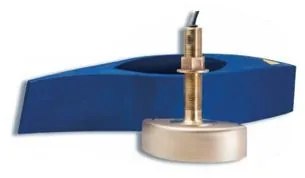
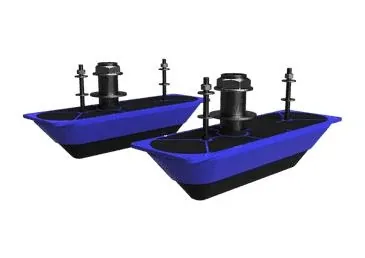
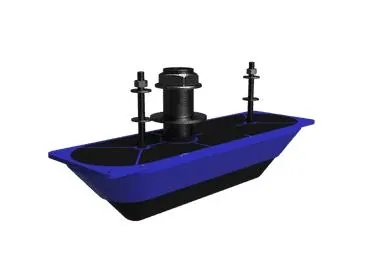
A tilted element housing fixes this at the factory. The face of the housing still mates to the hull, but the element inside is rotated so the beam comes out vertical. You buy the housing whose tilt matches your deadrise instead of fairing the angle in by hand.
Why the number on the housing matters
Tilt angles are offered in steps, and the step has to bracket the deadrise at the spot you drill, not the deadrise quoted for the boat. The usual selection is a 0° housing for a flat or near-flat run, 12° for moderate deadrise, and 20° for a steep V. Airmar builds its tilted element families this way, which is why the same transducer turns up in three listings with three different tilt numbers on the end.
Two things trip people up:
- Deadrise varies along the hull. The angle at the transom is not the angle amidships, and it changes again where a strake or a lifting pad interrupts the bottom. Measure at the mounting location with a digital level or angle finder, or get the figure from the builder for that station.
- A few degrees off is normal, many degrees off is not. Housings are stepped for a reason; the step has tolerance either side of it. Picking 12° for a 20° bottom leaves the beam 8° off vertical, which is most of the way back to the problem you paid to solve.
What the tilts look like in the catalogue
The Simrad xSonic line carries Airmar tilted element housings with the tilt in the model name, so you can match on sight:
- Simrad xSonic Airmar B150M — medium CHIRP thru-hull in bronze, listed in 0°, 12° and 20° tilt. Bronze suits fiberglass and wood hulls. This is the common fit for a center console or bay boat with moderate deadrise.
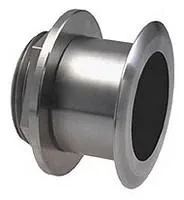
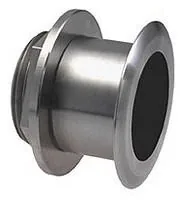
- Simrad xSonic Airmar SS175L 12° Tilt — low CHIRP, stainless steel, for steel or aluminum hulls. Low frequency is the deep-water band; on a hull that already needs stainless, the 12° housing covers a lot of production deadrise.
- Simrad xSonic Airmar SS175H-W 12° Tilt — high wide CHIRP, stainless steel, same 12° housing. High wide is the shallow-to-mid band where you want a wider cone and finer target separation.
The material letter is part of the name, not a cosmetic choice. Bronze goes in fiberglass and wood. Stainless goes in aluminum and steel, because bronze against aluminum sets up corrosion. If you are unsure which your hull needs, that is a question for the order, not for the drill.
Where a tilted element is the wrong answer
It is one mount among several, and it is not always the right one:
- Very steep or irregular deadrise. Past roughly the top of the 20° range, or where the bottom is curved or stepped at the mounting point, a fairing block or a custom-angle housing does the job a stock tilt cannot.
- Aluminum hulls that cannot take a hole. An in-hull or transom mount avoids cutting the bottom entirely.
- Trailer boats and kayaks. A transom mount adjusts for angle on its bracket and comes off with the boat.
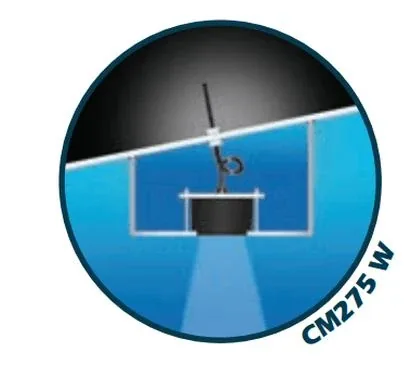
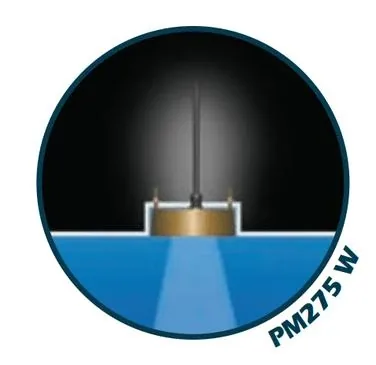
- Boats where you want to move the transducer. A thru-hull housing is drilled and sealed once. It is a permanent decision, and the tilt is part of it.
If you have not settled the mount yet, work through the transducer guide first — mount, frequency, power and connector, in that order. This page assumes the mount is already thru-hull.
What to send before you buy
Tilt is one of five things that have to line up: housing tilt, hull material, frequency band, power, and the connector your sounder or display takes. Get the tilt right and the connector wrong and the box still does not plug in.
Send us these and we will match the part before anything is invoiced:
- The hull — make, model, year, and whether it is fiberglass, aluminum or steel.
- Deadrise in degrees at the mounting location, if you have measured it. If not, say where on the bottom you plan to mount and we will work it out with you.
- The sounder, module or display the transducer plugs into, by model number.
- The deepest water you actually fish, and whether you want bottom hold at planing speed or fine detail over structure.
We check the order against your display and your boat — connector, sonar channels, mounting — before an invoice goes out. Nothing is charged on the site. The listings for these housings sit in Simrad transducers and the wider transducer department, and the general rules on connectors and frequencies are in the FAQ. When you are ready, send the hull and display details and we will come back with the right tilt and the right cable.