Why a moving boat draws an arch
A 2D sounder paints distance, not fish. Each ping measures how far away everything in the cone is, and the screen scrolls that column of returns across as time passes. A fish holding 14 feet down under a boat that is not moving is always 14 feet away, so it draws the same mark at the same place on every ping.
Move the boat and the geometry changes. The fish first appears at the outer edge of the cone, where it is furthest from the transducer and therefore drawn deepest on the screen. As the boat closes on it, the fish moves toward the center of the cone and its mark climbs. Directly under the transducer it is at its true depth, which is the top of the arch. Then the boat passes, the fish slides out the far side, and the mark sinks back down. The arch is that whole trip, drawn sideways by the scroll.
Why a stationary boat shows lines instead
Anchored, drifting slowly or sitting on spot-lock, a fish under you keeps a constant range, so it shows as a straight horizontal line, a short dash, or a stack of dashes that never curves. That is not a worse picture, it is the same fish. It is why ice anglers and jiggers read lines rather than arches: the flasher or scrolling 2D screen is showing a fish holding in the beam while the transducer stays still.
Drift and trolling speed change the same geometry. A slow drift or a slow troll stretches arches wide and flat. A fast run compresses them into steep, narrow humps, and at some speeds the returns smear together or disappear into the bottom trace.
What changes the shape of an arch
- Beam angle. A wide cone, such as a low-frequency 50 kHz beam, keeps the fish in the beam longer, so the arch is long and shallow. A narrow high-frequency beam, 200 kHz or a high CHIRP band, gives a short, tall, tight arch.
- Depth. A fish further from the transducer takes longer to cross the cone, so a deep arch is wider than a shallow one.
- Boat speed and scroll speed. Faster boat, tighter arch. Faster scroll, wider arch on the screen.
- Fish size and body. A bigger target returns a thicker, brighter arch. A fish with no swim bladder, or one lying flat on hard bottom, may barely arch at all.
What is not a fish
Arches come from other things. A submerged log, a mooring line, a bubble stream, the edge of a thermocline, propeller wash or your own wake can all curve. The test is consistency: a real fish arch is solid, has a clear top, and does not repeat identically in the same place ping after ping. Structure holds its shape, fish move.
Why live sonar shows fish differently
Live sonar, forward-facing or real-time beam sonar, is not a scrolling history of range. It draws the water ahead of or around the boat as a live picture several times a second, so a fish shows as a bright target that moves, follows a jig, or turns on a bait ball. There is no arch because there is no boat travelling across a fixed cone to draw one. You read the fish's position and direction instead of its range history.
Imaging sonar sits in between. Down imaging and side imaging show fish as bright dots, short streaks and blobs with shadows on the bottom rather than arches, because they build the picture from a thin fan of beams instead of a cone.
Why this matters when you buy
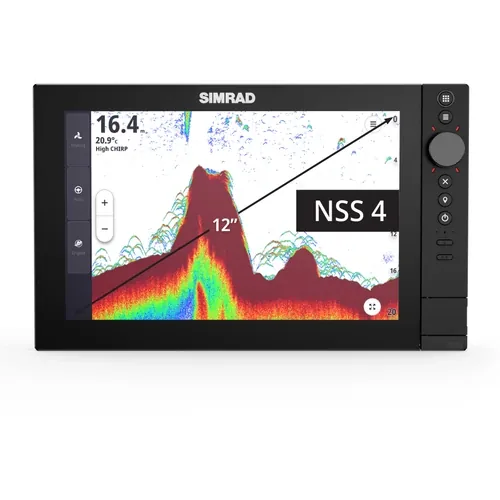
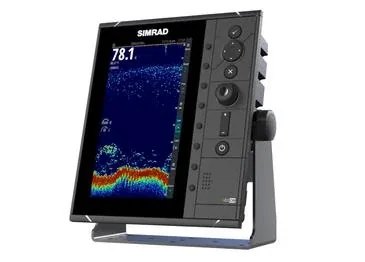
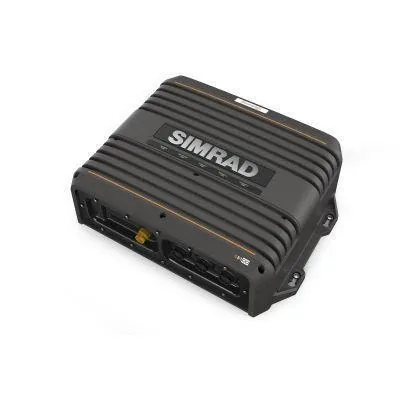
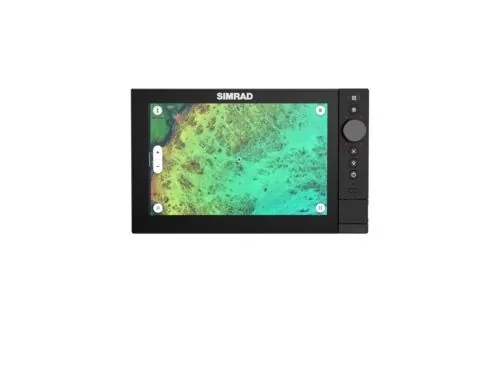
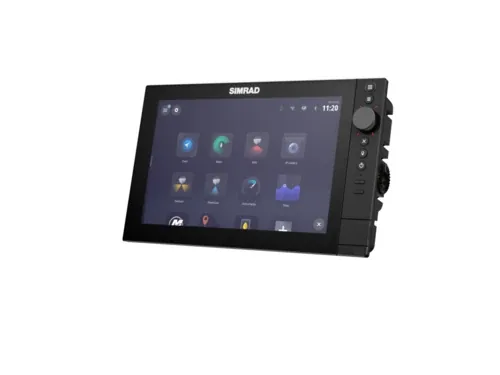
If reading arches is the point, the sounder and the transducer both have to be up to it. A dedicated black-box sounder with CHIRP gives clean target separation and a screen you can scroll slowly. A multifunction display with an internal sounder does the same job when the transducer matches its channels and connector. Right beam angle and right mount and the arches are there; wrong ones and no amount of screen size will fix it.
Simrad sounders and displays are in the Simrad fish finder listings, with the wider range under fish finders and depth sounders. Transducers are in transducers, and the transducer guide covers mount, frequency, power and connector. If you are matching a transducer to a display you already own, the FAQ covers compatibility, and contact is where you send the model and hull.