What Puget Sound asks of a radar
Puget Sound is deep, cold, tidal water with land never far away, and the seaward entrance runs out through the Strait of Juan de Fuca past the shipping lanes into Seattle and Tacoma. That combination sets the job description.
- Fog and driving rain. Seasonal fog sits in the Sound in fall and winter, and steady rain cuts X-band range. You need a picture you can read at eighth-of-a-mile to two miles, not a marketing range figure.
- Ferries crossing the lanes. Washington State Ferries runs the largest ferry fleet in the country out of about 20 terminals, and those boats cross the commercial shipping lanes at close to right angles. A ferry at 16 knots, or a passenger boat at 35, closes fast and comes at you from the side.
- Commercial traffic. Deep-draft ships, tugs and barges work the same water under Seattle's Vessel Traffic Service, which talks to them on its own VHF channel. Monitor it.
- Small boats in the lanes. In fall the salmon fleet trolls at 2 or 3 knots right along the edges of the shipping channel. Slow targets, changing course, often invisible in a chop.
Radar shows you the ferry and the log boom; AIS tells you the ferry's name, course and closing speed before the echo firms up. Run both. Our AIS transponders go on the same network as the radar.
Short range with a fast refresh beats long range
Most radar shopping is done on the range number. In Puget Sound that number is close to meaningless — you are seldom more than a few miles from shore, and nothing you need to avoid is 40 miles out. What decides whether you see a skiff in the fog is target separation at short range and how often the picture refreshes.
Antenna rotation is the part buyers skip. A scanner turning at 48 rpm paints the whole screen three times as often as one at 16 rpm, which is what you want when a fast passenger ferry is bearing down. The X-Class open arrays in our Furuno radar range list 24, 36 and 48 rpm modes for exactly this.
Which radar suits which Washington boat
Trailer boats, kayaks-adjacent skiffs and sailboats: a radome
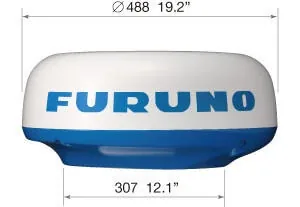
The Furuno DRS4D-NXT is a 25 W solid-state Doppler radome. No magnetron means no warm-up and no standby time — it is transmitting the moment you switch it on, which matters when the fog arrives faster than your patience. Doppler colours targets that are closing on you, so a ferry coming at 30 knots stands out from the shoreline clutter. It also draws little power and mounts low, which is what a boat on a trailer or under a bridge needs.
Center consoles and sportfishers working offshore: open array
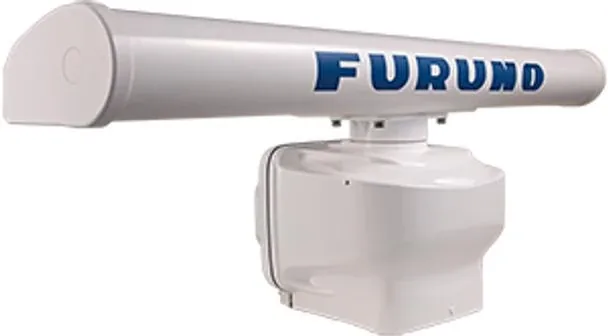
If you run out the Strait for halibut and tuna, or down the coast, an open array earns its money. The X-Class drive units come in 6 kW, 12 kW and 25 kW, all rated to 96 NM, with the heavier magnetron buying you smaller targets in rain and slop. The 25 kW DRS25A-X is the long-range unit; the 6 kW DRS6A-X is the sensible middle for a 30- to 40-foot boat that mostly stays inside the Sound but wants range when it goes out.
Watch the wording on open-array listings: several of ours are drive unit only, with the antenna sold separately. Say which antenna length you need when you ask for a quote and it goes on the invoice correctly.
Boats with no multifunction display: a self-contained radar
Not every Washington boat has a glass bridge, and not every owner wants one. The Furuno M-1815 is a complete 4 kW radar with its own 8.4-inch colour display and a 10-metre cable. It stands alone — no chartplotter required — which suits a small cruiser, a workboat or an older hull where you would rather not rewire the helm.
Columbia River: Buoy 10, sandbars and 700-foot ships
The lower Columbia is a different problem. From Buoy 10 up past the Astoria-Megler Bridge, the August and September chinook and coho run draws a dense fleet of trollers into a shipping channel that loaded freighters also use — a ship that size can take a mile to stop, so you give way, not the other way round.
Fog banks roll in off the bar at first light, which is exactly when the bite is best. Two things matter on the river that matter less in the Sound:
- Chart overlay on the radar picture. The channel, the jetties and the buoy line need to sit on top of the echoes, because the bottom moves. Sandbars shift year to year.
- Tight short-range gain control. You are picking out 16-foot boats among tide rips and chop in an estuary with 45-foot holes and shallow flats side by side. A radome that separates a boat from a breaking ripple at 300 yards is the right tool.
A radar with chart overlay needs a display to overlay onto. Our GPS chartplotters and multifunction displays are the pairing.
Lake Washington and the Ship Canal: height is the constraint
Lake Washington is fresh, deep and urban — sockeye and kokanee, cutthroat, bass and perch, with Seattle's floating bridges across it and the Ship Canal bascule bridges at the west end. Those bridges put a hard ceiling on how tall your boat and radome can be, so a low-profile radome on a short mount is usually the only option, and an open array with a 4- or 6-foot bar rarely fits under the crossings without a lowering mast.
Radar is less about traffic on the lake and more about the fog that forms on cold mornings and the dark run home. A radome here does double duty: it is small enough to live under the bridge and good enough to see a kayak or a moored buoy at 200 yards.
What belongs on the invoice with the radar
A radar is never just the scanner. Before we send an invoice we check the whole chain against your boat and your display:
- The display. Furuno radars need a Furuno multifunction display or TZtouch unit to talk to. Name your display model and we confirm the radar is compatible before you pay.
- Cable length. The run from the mast to the helm decides which cable you need. Measure it, don't guess.
- Heading sensor. Radar overlay on a chart and MARPA target tracking both need a heading input, not just GPS course.
- Mount and clearance. Radome or array, the mount has to clear the bridges you actually run under.
- Power. Open arrays pull real current. Check what your panel and wiring will carry.
Send your display model, your boat and the water you run, and we match it. If something will not fit, you hear it before you pay, not after. Start at contact or read the FAQ.
Shipping radar to Washington
Washington is in our Plains, Mountain & West zone. We dispatch in 1–3 business days once payment clears, then transit is 3–8 business days. Shipping is priced to your ZIP code and confirmed on the invoice before you pay, and every parcel is tracked and insured.
There is no showroom, pickup or installation — we ship only, from Miami. Nothing is charged on this website: you send your details, we check compatibility, and you pay the emailed invoice by card link, ACH or wire, or Zelle. Full detail is on the shipping policy.
Everything we sell is new and carries the manufacturer's own warranty. Unused items in original, unopened packaging can come back within 30 days with no restocking fee.